
O que é uma Máquina de Luvas de Plástico Descartável?
In sectors where hygiene and safety are paramount, such as healthcare, food service, and cleanroom environments, disposable gloves are an indispensable part of daily operations. But have you ever paused to consider the technology behind the production of these essential items? The unsung hero of this process is the máquina de luvas de plástico descartáveis, a sophisticated piece of equipment engineered for precision, speed, and reliability. For buyers and industry professionals, understanding the mechanics and capabilities of these machines is crucial for making informed investment decisions that can significantly impact operational efficiency and product quality.
From raw material to finished product, the journey of a disposable glove is a marvel of modern automation. This comprehensive guide will delve into the world of disposable glove manufacturing, exploring the intricate processes, the different types of machines available, and the key features that define a high-quality production line. We will also highlight how industry leaders like Damao Tec are pushing the boundaries of innovation to deliver machinery that meets the evolving demands of the global market.
The Evolution of Glove Manufacturing: From Manual Labour to High-Speed Automation
The production of disposable gloves has transformed dramatically over the decades. Early methods were labour-intensive and slow, often resulting in inconsistent quality. The advent of automation revolutionised the industry, paving the way for machines that could produce thousands of gloves per hour with minimal human intervention. This shift not only boosted production volumes but also enhanced hygiene standards by reducing manual contact during the manufacturing process.
Today’s state-of-the-art disposable plastic glove machines, like those engineered by Damao Tec, represent the pinnacle of this evolution. Integrating advanced robotics, intelligent control systems, and precision engineering, these machines offer unparalleled efficiency, consistency, and versatility, making them a cornerstone of modern personal protective equipment (PPE) production.
How Does a Disposable Plastic Gloves Machine Work? A Step-by-Step Breakdown
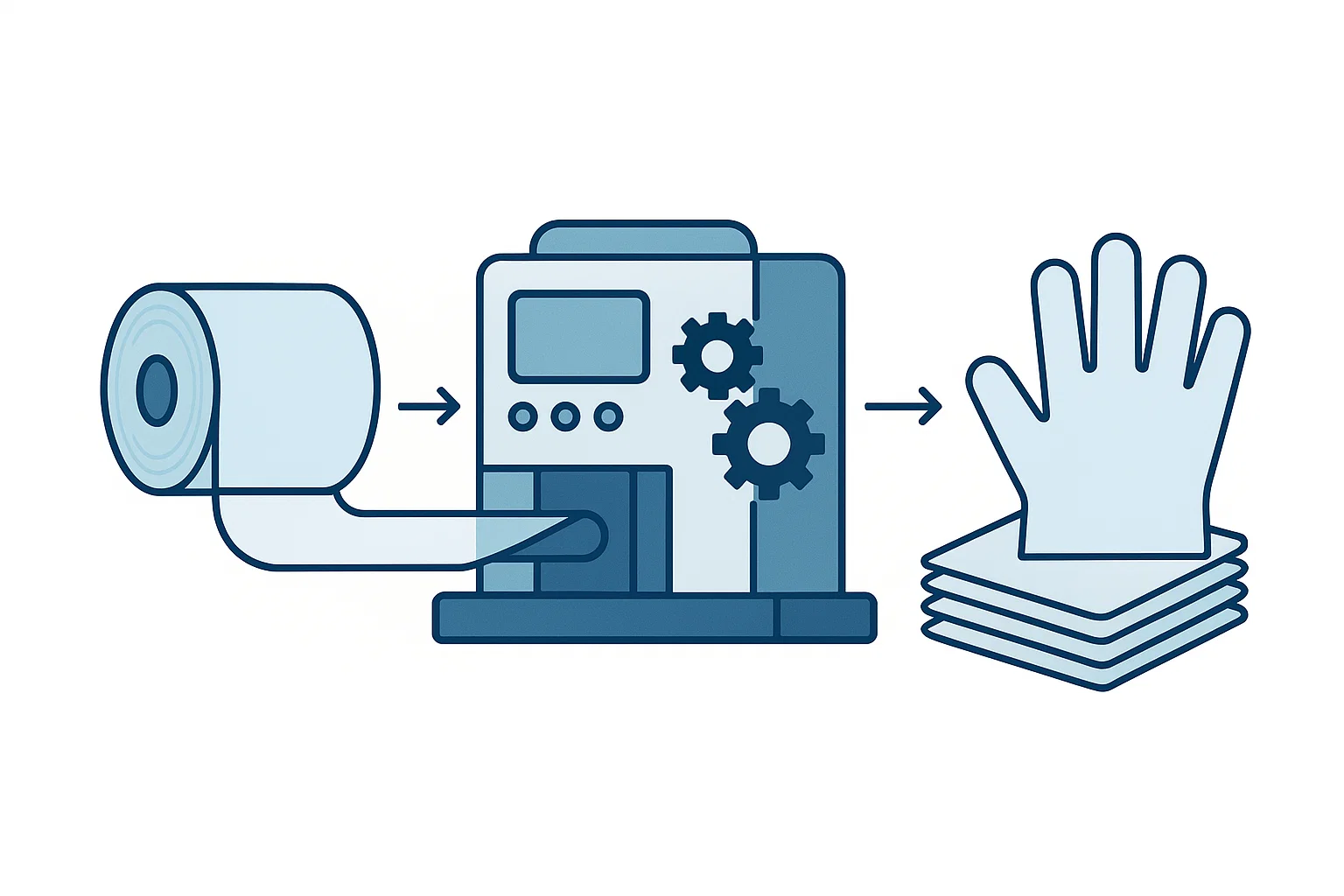
While different machines exist for various materials like PE and TPE, the fundamental process of converting plastic film into a finished glove involves several key stages. A modern, fully automatic line automates each step for a seamless workflow.
1. Material Feeding and Unwinding
The process begins with a large roll of plastic film—typically polyethylene (PE) or thermoplastic elastomer (TPE)—loaded onto the machine. An automated unwinding system, often controlled by a frequency converter, feeds the film with high precision to ensure a smooth and consistent supply into the production line.
2. Film Forming and Heating
For certain types of gloves, particularly those made from materials like CPE (chlorinated polyethylene) or TPE, the machine first forms two layers of film in parallel. These layers are then heated to the optimal temperature, preparing them for the crucial moulding stage. This heating process ensures the material is pliable enough to be sealed and cut accurately.
3. Glove Moulding, Sealing, and Cutting
This is the core of the manufacturing process where the glove takes shape. The heated plastic film passes through a station equipped with a hand-shaped mould. The machine uses a heat-sealing and cutting mechanism to press the layers of film together, simultaneously welding the edges and cutting out the glove’s outline. The quality and precision of this mould are paramount to producing a glove that is not only perfectly shaped but also has strong, reliable seams. Companies like Damao Tec invest heavily in the engineering of these moulds to guarantee consistency and durability.
4. Automatic Waste Stripping
Once the glove shape is cut, the surrounding excess film, known as waste material, must be removed. In older, semi-automatic systems, this required manual labour. However, a fully automatic disposable gloves machine integrates an automated waste stripping unit. This system mechanically separates the waste from the finished gloves, which can then be collected for recycling, improving sustainability and reducing manual effort.
5. Counting and Stacking
In the final stage, the finished gloves are automatically counted and stacked. Advanced systems use sensors to ensure accurate counts before stacking the gloves neatly, ready for packaging. This automation minimises handling, maintains hygiene, and prepares the product for distribution efficiently.
Types of Disposable Plastic Gloves and Their Specialised Machines
The term “plastic gloves” covers a range of materials, each suited to different applications and requiring specific machine configurations.
- PE (Polyethylene) Glove Machines: PE gloves, made from either High-Density (HDPE) or Low-Density (LDPE) polyethylene, are the most common and cost-effective type of disposable plastic glove. They are widely used in the food service industry for tasks that require frequent glove changes. PE glove machines are designed for high-speed production of these lightweight gloves.
- TPE (Thermoplastic Elastomer) Glove Machines: TPE gloves offer a significant upgrade from standard PE gloves. They provide a softer, more flexible fit with better elasticity, often compared to vinyl gloves. TPE machines, such as those developed by Damao Tec, are engineered to handle the unique properties of this material, ensuring a high-quality finish and comfortable user experience.
- CPE (Chlorinated Polyethylene) Glove Machines: CPE gloves are known for their durability and soft feel. The production machines for CPE gloves are similar to TPE machines, involving a film-casting or blowing process followed by heat sealing and cutting.
Key Features to Consider When Investing in a Disposable Plastic Gloves Machine
For buyers and production managers, selecting the right machine is a critical decision that impacts productivity, cost, and market competitiveness. Here are the essential features to evaluate:
- Production Speed and Capacity: Look for a machine that can meet your volume demands. High-speed models can produce anywhere from 40 to over 140 pieces per minute per line, with many machines featuring a dual-line setup to double the output.
- Level of Automation: A máquina de luvas descartáveis completamente automática significantly reduces labour costs and the potential for human error. Features like automatic waste removal, counting, and stacking are essential for a truly efficient and hygienic production line.
- Material Compatibility and Versatility: A machine that can handle various materials like PE, CPE, and TPE provides greater flexibility to meet diverse market needs and adapt to changing customer demands. The ability to customise glove shapes and sizes is also a significant advantage.
- Build Quality and Component Reliability: The machine’s longevity and performance depend on its construction and the quality of its components. Look for machines built with a robust steel frame for stability and equipped with reliable electronics from reputable brands. Damao Tec, for instance, utilises a microcomputer touchscreen and high-quality components to ensure dependable, low-noise operation.
- Energy Efficiency and Operating Costs: In today’s competitive market, minimising operational expenses is key. An energy-efficient design not only lowers electricity bills but also contributes to a more sustainable manufacturing process, offering a faster return on investment.
- After-Sales Service and Technical Support: A reliable manufacturer provides comprehensive support, including installation, training, and readily available spare parts. This partnership is crucial for ensuring minimal downtime and maintaining peak production efficiency.
Why Damao Tec Sets the Standard in Disposable Glove Machine Technology
In the specialised field of protective equipment manufacturing, Damao Tec has established itself as a trusted leader through a relentless commitment to quality, innovation, and customer-centricity. Our deep-seated Experience in the industry is reflected in the robust design and superior performance of our machines. We demonstrate our Expertise by integrating cutting-edge automation and intelligent control systems that empower our clients to achieve unparalleled production efficiency.
Nosso Authoritativeness is built on a foundation of proven success, with Damao Tec machines operating in facilities worldwide, consistently delivering high-quality products. Most importantly, we earn our clients’ Trustworthiness through transparent processes, reliable after-sales support, and machinery that is built to last. By choosing Damao Tec, you are not just buying a machine; you are investing in a partnership dedicated to your success.
The Future of Glove Production: Sustainability and Smart Technology
The future of disposable glove manufacturing is being shaped by two major trends: sustainability and smart technology. Manufacturers are increasingly looking for machines that minimise waste and can process biodegradable or recyclable materials. Simultaneously, the integration of IoT (Internet of Things) and AI-driven analytics will enable “smart” production lines that can self-diagnose issues, optimise performance in real-time, and provide valuable data for production planning. Damao Tec está ativamente envolvido em pesquisa e desenvolvimento para incorporar estas características de futuro nos nossos próximos modelos de máquinas para luvas de plástico descartáveis.
Conclusão
The máquina de luvas de plástico descartáveis É um ativo crítico para qualquer fabricante nas indústrias de EPI (Equipamento de Proteção Individual), serviços alimentícios ou suprimentos médicos. Mais do que um item de equipamento, é o motor da produção, influenciando diretamente a produção, a qualidade e a lucratividade. Ao entender o processo de fabricação detalhado, os diferentes tipos de máquinas e as características principais a serem observadas, compradores e profissionais da indústria podem fazer investimentos estratégicos que geram benefícios a longo prazo.
À medida que a automação e a tecnologia continuam a avançar, associar-se a um fabricante experiente e inovador como Damao Tec garante que você tenha as ferramentas e o suporte necessários para prosperar em um cenário competitivo, fornecendo produtos essenciais que protegem pessoas e processos em todo o mundo.
Perguntas Frequentes (FAQ)
1. Qual é a principal diferença entre uma máquina de luvas descartáveis semi-automática e uma completamente automática?
Uma máquina semi-automática geralmente requer intervenção manual para certos passos do processo, mais comumente a remoção da película de resíduo após o corte das luvas. Uma máquina completamente automática, por outro lado, integra sistemas automatizados para todas as etapas, incluindo alimentação de material, selagem, corte, remoção de resíduos e contagem, o que reduz significativamente os custos de mão de obra e aumenta a eficiência.
2. Quais materiais-primos uma máquina de luvas descartáveis versátil pode manipular?
Máquinas de alta qualidade e versáteis são projetadas para serem compatíveis com uma variedade de filmes termoplásticos. Os materiais mais comuns são o HDPE (Polietileno de Alta Densidade) e o LDPE (Polietileno de Baixa Densidade). Muitos modelos avançados, incluindo aqueles da Damao Tec, também podem processar eficientemente filmes de CPE (Polietileno Clorado) e TPE (Termoplástico Elástico), permitindo que os fabricantes produzem diferentes tipos de luvas para atender a várias demandas do mercado.
3. Quanto de manutenção uma máquina de luvas descartáveis requer?
Máquinas modernas são projetadas para durabilidade e facilidade de manutenção. A manutenção regular geralmente inclui a limpeza dos moldes de selagem e corte, verificação da tensão do sistema de alimentação e garantia de que os componentes eletrônicos e sistemas de controle estão funcionando corretamente. Máquinas com componentes de alta qualidade e sistemas de lubrificação convenientes simplificam este processo, garantindo uma vida operacional mais longa e desempenho consistente.
4. Pode o tamanho e a forma das luvas serem personalizadas na máquina?
Sim, uma das principais características das máquinas de luvas descartáveis modernas é a capacidade de personalização do produto. O formato e o tamanho da luva são determinados pelo molde utilizado na estação de selagem e corte. Esses moldes são geralmente intercambiáveis, permitindo que os fabricantes produzem uma variedade de tamanhos (por exemplo, pequeno, médio, grande) e até formas personalizadas para atender a aplicações específicas ou requisitos de clientes.