EVA Foam Density & Hardness Guide: Shore A vs Shore C Explained
Selecting the correct EVA foam is not simply a matter of softness or thickness. In industrial manufacturing, footwear development, marine applications, and protective packaging, densidad y Shore hardness directly affect durability, energy return, machinability, and service life.
At Damao Tech, we manufacture hojas y rollos de espuma EVA with tightly controlled density and hardness ranges to support precise engineering requirements.
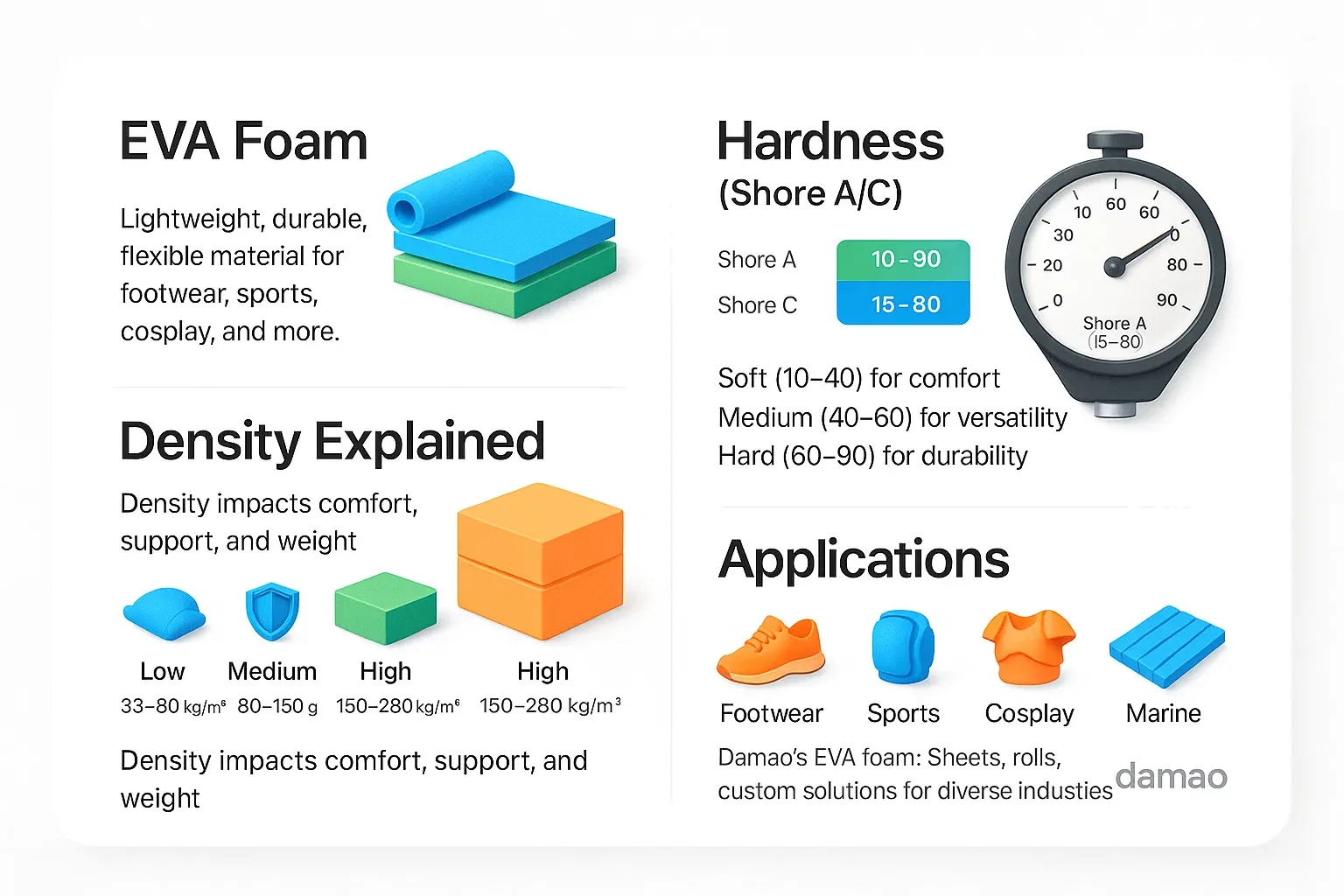
Density and Shore hardness are correlated but fundamentally different parameters. Density primarily affects weight, compression resistance, and structural stability, while Shore hardness measures surface resistance to indentation under a standardized load.
1. EVA Foam Density Classification (kg/m³)
Density determines how much material mass exists per unit volume. Higher-density EVA generally provides better load-bearing capacity, dimensional stability, and abrasion resistance, while lower-density foam prioritizes cushioning and weight reduction.
Low Density (33–80 kg/m³)
Used for yoga mats, soft protective packaging, flotation inserts, and comfort-focused cushioning where low weight and compressibility are critical.
Medium Density (80–150 kg/m³)
The most common range for athletic footwear midsoles, orthotic components, sports equipment padding, and general-purpose industrial foam parts.
High Density (150–280 kg/m³)
Preferred for marine decking, industrial gaskets, tool control foam, and applications requiring higher stiffness, wear resistance, and shape retention.
2. EVA Foam Hardness Testing Standards (Shore A & Shore C)
EVA foam hardness is commonly measured using ASTM D2240. Due to EVA’s cellular structure, different Shore scales are used depending on formulation and industry.
- Shore C: Common in footwear, sports, and foam-specific industries
- Shore A: Used when comparing EVA to rubber or elastomer components
Because Shore A and Shore C use different indenters and spring forces, there is no exact mathematical conversion between the two scales. The table below reflects commonly observed industry reference ranges.
| Shore C (EVA Foam) | Approx. Shore A | Typical Application |
|---|---|---|
| 15 – 25 C | 5 – 10 A | Extra-soft cushioning, therapeutic insoles |
| 35 – 45 C | 20 – 25 A | Standard athletic midsoles, shock-absorbing pads |
| 55 – 65 C | 35 – 45 A | Marine decking, tool control foam, protective panels |
| 75 – 85 C | 55 – 70 A | Rigid industrial parts, structural foam components |
Shore A and Shore C values above are approximate reference ranges based on common EVA foam formulations. Actual test results may vary depending on density, expansion ratio, cell structure, and test conditions. Always validate material specifications with physical samples.
3. How Engineers Select EVA Foam: A Practical Logic
Instead of choosing density or hardness in isolation, engineers typically work backward from functional requirements:
- Focus on cushioning or energy absorption?
→ Start with Shore C range, then adjust density for durability. - Concerned about dimensional stability or machining?
→ Start with density, then fine-tune hardness. - Heat forming or thermo-molding required?
→ Medium-to-high density with moderate Shore C improves edge definition. - Outdoor or marine exposure?
→ Higher density and mid-to-high Shore C for wear resistance and traction.
4. Application-Based Specification Reference
- Calzado: Low-to-medium density, 20–35 Shore C for comfort and rebound
- Marina: High density, 60–65 Shore C for UV resistance and anti-slip performance
- Cosplay & Props: Medium-to-high density, 45–70 Shore C for heat shaping and durability
- Protective Packaging: Densidad baja, 35–45 Shore C para absorción de choques
5. Preguntas Frecuentes
Sí. Ajustando la formulación y el ratio de expansión, se pueden lograr niveles específicos de dureza Shore en diferentes rangos de densidad, dentro de los límites prácticos.
P: ¿Ofrecen folletos técnicos y muestras?Sí. Proporcionamos folletos técnicos y muestras físicas para validación, lo cual se recomienda encarecidamente para aplicaciones críticas.
¿Necesita soporte de espuma de EVA a nivel de ingeniería?
Solicite folletos técnicos, muestras de dureza Shore o recomendaciones específicas de aplicación de nuestro equipo de materiales.
Contacte con nosotros para soporte técnico