EVA Foam Density & Hardness Guide: Shore A vs Shore C Explained
Selecting the correct EVA foam is not simply a matter of softness or thickness. In industrial manufacturing, footwear development, marine applications, and protective packaging, density 熱可塑性ポリウレタン(TPU)です。 Shore hardness directly affect durability, energy return, machinability, and service life.
At Damao Tech, we manufacture EVA foam sheets and rolls with tightly controlled density and hardness ranges to support precise engineering requirements.
Density and Shore hardness are correlated but fundamentally different parameters. Density primarily affects weight, compression resistance, and structural stability, while Shore hardness measures surface resistance to indentation under a standardized load.
1. EVA Foam Density Classification (kg/m³)
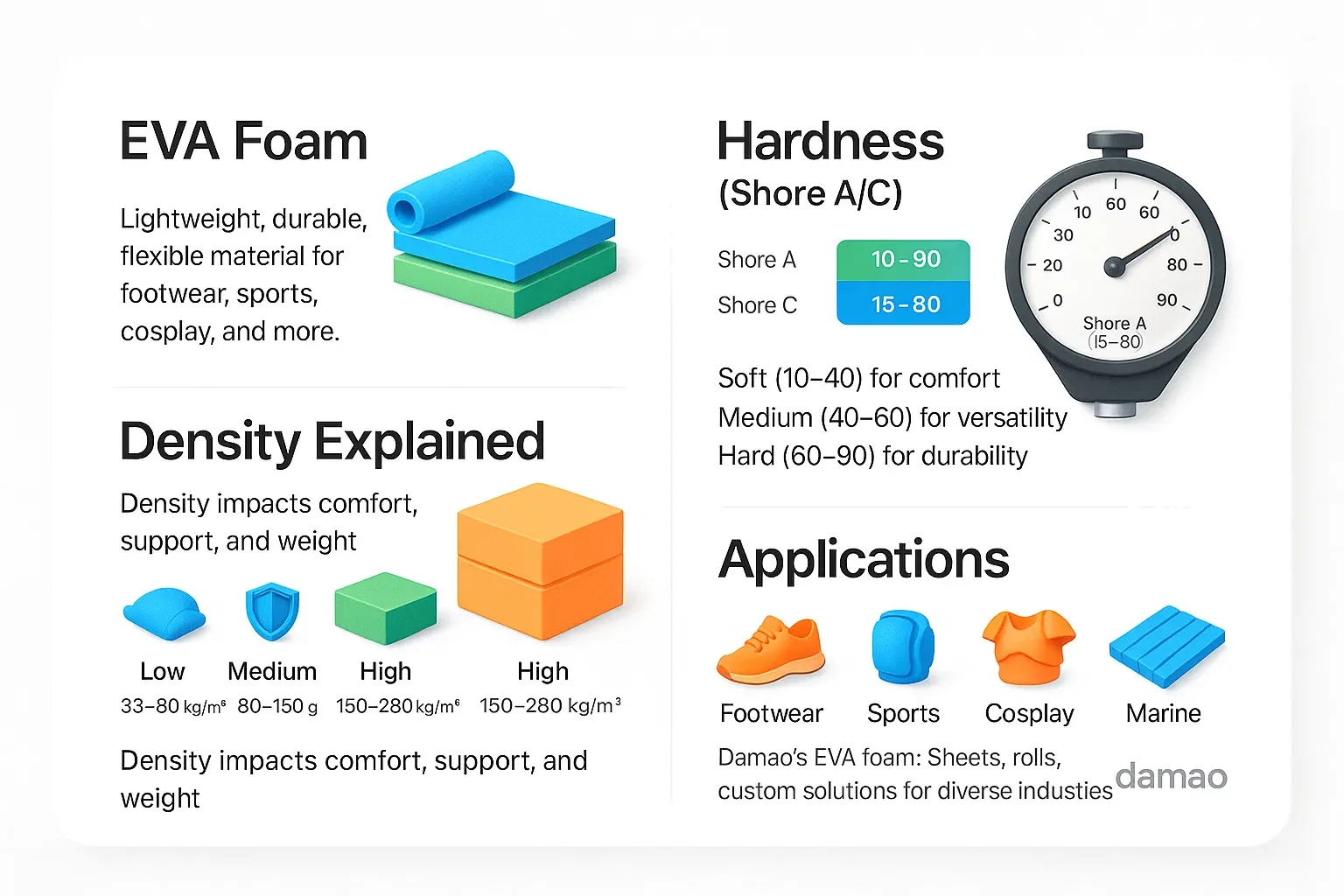
Density determines how much material mass exists per unit volume. Higher-density EVA generally provides better load-bearing capacity, dimensional stability, and abrasion resistance, while lower-density foam prioritizes cushioning and weight reduction.
Low Density (33–80 kg/m³)
Used for yoga mats, soft protective packaging, flotation inserts, and comfort-focused cushioning where low weight and compressibility are critical.
Medium Density (80–150 kg/m³)
The most common range for athletic footwear midsoles, orthotic components, sports equipment padding, and general-purpose industrial foam parts.
High Density (150–280 kg/m³)
Preferred for marine decking, industrial gaskets, tool control foam, and applications requiring higher stiffness, wear resistance, and shape retention.
2. EVA Foam Hardness Testing Standards (Shore A & Shore C)
EVA foam hardness is commonly measured using ASTM D2240. Due to EVA’s cellular structure, different Shore scales are used depending on formulation and industry.
- Shore C: Common in footwear, sports, and foam-specific industries
- Shore A: Used when comparing EVA to rubber or elastomer components
Because Shore A and Shore C use different indenters and spring forces, there is no exact mathematical conversion between the two scales. The table below reflects commonly observed industry reference ranges.
| Shore C (EVA Foam) | Approx. Shore A | 典型的な適用例 |
|---|---|---|
| 15 – 25 ℃ | 5 – 10 A | エクストラソフトクッション、治療用インソール |
| 35 – 45 ℃ | 20 – 25 A | 標準的なアスリートミッドソール、衝撃吸収パッド |
| 55 – 65 ℃ | 35 – 45 A | 海上デッキ、ツールコントロールフォーム、保護パネル |
| 75 – 85 ℃ | 55 – 70 A | 剛性の工業部品、構造用フォームコンポーネント |
上記のShore AおよびShore C値は、一般的なEVAフォームの配合に基づく推定の参考範囲です。 実際のテスト結果は、密度、拡張率、細胞構造、およびテスト条件によって異なる場合があります。 常に物理サンプルで素材仕様を確認してください。.
3. 工学者が選択するEVAフォーム:実践的な論理
密度や硬度を単独で選択する代わりに、 工学者は機能要件から逆算して作業します:
- クッション性やエネルギー吸収に焦点を当てますか?
→ Shore C範囲から始め、耐久性のために密度を調整します。. - 寸法安定性や加工に懸念がありますか?
→ 密度から始め、硬度を微調整します。. - ヒートフォーミングやテーモモoldingが必要ですか?
→ 中から高密度で適度なShore Cがエッジの定義を改善します。. - 屋外や海上の露出?
→ 耐摩耗性とグリップ性のため、高密度と中から高Shore Cが求められます。.
4. 機種別の仕様参照
- 靴: 低から中密度、20–35 Shore Cで快適さと反発性
- 海上: 高密度、60–65 Shore CでUV耐久性と防滑性能
- コスプレ&プロップス: 中から高密度、45–70 Shore Cで熱形成と耐久性
- 保護包装: 低密度、35–45 Shore C で衝撃吸収
5.よくある質問
はい。配合と拡張率を調整することで、異なる密度範囲内で特定のShore硬度レベルを達成できます。実用的な限界内でのことです。.
Q: 技術データシートとサンプルを提供していただけますか?はい。重要なアプリケーションには強く推奨しますが、素材データシートと物理的なサンプルを提供しています。.
エンジニアリングレベルのEVAフォームサポートが必要ですか?
技術データシート、Shore硬度サンプル、アプリケーション固有の推奨から、私たちの素材チームにご依頼ください。.
技術サポートのご連絡先はこちら