Custom EVA Foam Fabrication Services: The Complete Guide
- Damao Tech
- EVA Foam
- 22 May, 2025
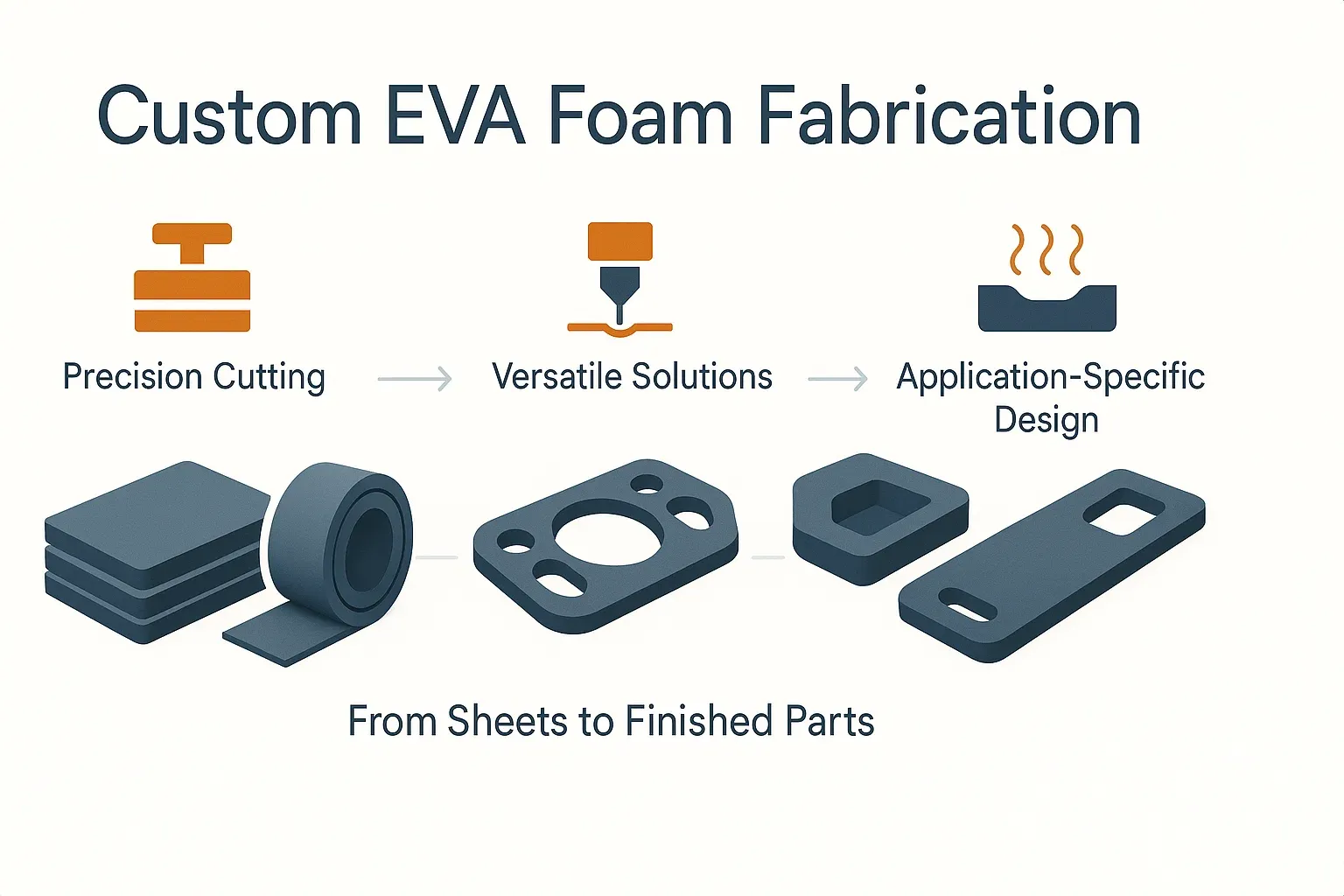
Our custom EVA foam fabrication services transform technical material data into application-specific components for industrial and consumer markets. By utilizing advanced manufacturing technologies, we help engineers optimize their part designs for weight, durability, and cost-effectiveness.
In our experience at Damao, the choice of fabrication method is the primary driver of production efficiency. Whether you require a single prototype or a high-volume manufacturing run, matching the process to your project’s scale prevents technical bottlenecks and reduces material waste. For a foundational understanding of the material grades available, visit our EVA foam pillar page.
The Volume-to-Value Selection Matrix
The volume-to-value matrix is a technical decision framework used by procurement managers to select the most economical fabrication method based on production scale. Understanding these thresholds prevents over-investment in tooling for small batches and reduces high labor costs during mass production.
| Production Volume | Recommended Method | Tooling Cost | Primary Advantage |
|---|---|---|---|
| 1 – 100 Units | CNC Routing | Zero | Rapid Prototyping |
| 100 – 1,000 Units | Waterjet / CNC | Low | High Complexity |
| 1,000 – 10,000+ | Die Cutting | Moderate | Lowest Unit Cost |
| 3D Complex Parts | Thermoforming | High | Ergonomic Shaping |
Advanced CNC Routing Capabilities
CNC (Computer Numerical Control) routing is a dieless fabrication process that uses computer-guided rotating bits to carve EVA foam with high precision. Unlike traditional methods, CNC allows for “blind pockets” and “multi-depth steps”—features that are essential for high-end tool organization and complex equipment inserts.
- Blind Pockets: Recesses that are carved into the foam sheet without cutting through the entire thickness.
- Beveled Edges: Specific angled profiles that improve the fit and finish of consumer electronics packaging.
- Variable Depths: The ability to secure items of different heights within a single foam tray.
Because CNC routing relies on digital CAD/CAM files rather than physical dies, design updates can be implemented in minutes. This makes it the ideal choice for iterative design cycles where specifications are finalized during the prototyping stage.
The Die Cutting Cross-over Point
Die cutting is a high-speed mechanical process that uses a steel-rule die to punch shapes out of EVA foam sheets. While the process requires an upfront investment in custom tooling, the “die cutting cross-over point” is the specific volume where lower unit costs begin to outweigh the initial setup expense.
For standard gaskets and inserts, this transition typically occurs at approximately 1,000 units. Beyond this volume, the instantaneous “cookie-cutter” action of a die press is significantly faster than the linear travel speed of a CNC bit or waterjet head. To achieve the best ROI, move to die cutting once your product design is validated and production volumes are stable.
Prototyping-to-Production Roadmap
A technical roadmap ensures a smooth transition from a digital concept to a mass-produced component. Following these steps reduces the risk of expensive errors and ensures the final part meets all safety and performance benchmarks.
- Digital CAD Review: Finalize technical drawings and verify all critical dimensions and tolerances.
- Dieless Prototyping: Use CNC routing to produce first-run samples for physical validation.
- Validation & Adjustment: Test the prototype in the final assembly and adjust the digital file if necessary.
- Tooling Fabrication: Commit to a physical die or mold once the field-test results are successful.
- Full-Scale Production: Execute the production run using the most cost-effective method identified in the volume matrix.
Custom Finishing and Assembly Options
Professional fabrication services extend beyond simple cutting. Adding functional or aesthetic finishes can improve the utility and brand recognition of your EVA foam components.
- Lamination: Bonding EVA foam to fabrics, plastics, or pressure-sensitive adhesives (PSA).
- Laser Engraving: Adding permanent logos, instructions, or identification codes to the foam surface.
- Edge Finishing: Smoothing or “skiving” edges to prevent snagging in industrial machinery applications.
Partner with Damao for Technical Excellence
At Damao, we provide the technical material knowledge and advanced fabrication capabilities needed to execute your project with precision. We pride ourselves on optimizing material usage and reducing waste in every custom project we handle.
Ready to start your custom project? Contact Damao today to discuss your fabrication requirements and request a technical consultation from our engineering team. For material options, density ranges, and core manufacturing capabilities, start from our custom EVA foam manufacturer page.