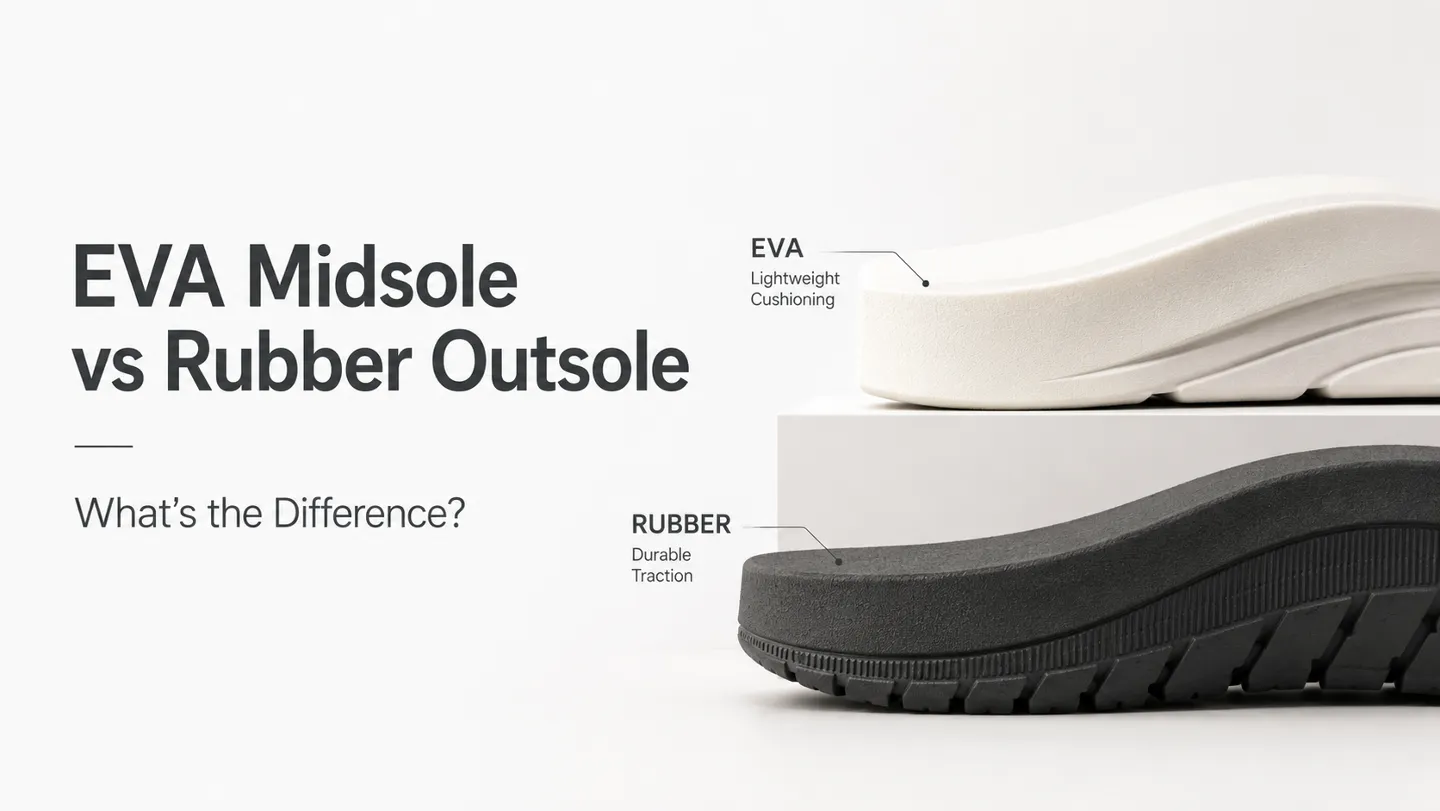
EVA Midsole vs Rubber Outsole: What's the Difference?
- Damao Tech
- EVA Foam
- 13 Jun, 2026
Shoe buyers and footwear engineers often use “midsole” and “outsole” interchangeably — and that single misunderstanding leads to poor material selection and premature sole failure. This guide separates the two layers, explains exactly what the EVA midsole and rubber outsole each do, and shows you which combination delivers the best performance for any application.
What Is an EVA Midsole?
An EVA midsole is the cushioning layer sandwiched between the upper shoe and the ground-contact outsole. It is made from Ethylene-Vinyl Acetate (EVA) foam — a lightweight, closed-cell elastomer that compresses on impact and springs back to its original shape, absorbing kinetic energy before it reaches the foot.
Because EVA foam weighs roughly 0.9–1.1 g/cm³ — significantly less than rubber — the midsole contributes the majority of a shoe’s comfort without adding bulk. Running shoes, athletic trainers, and hiking boots all rely on an EVA midsole to reduce fatigue over long distances.
Key functions of the EVA midsole:
- Shock absorption: Dissipates ground-reaction forces at heel strike and forefoot push-off.
- Energy return: High-resilience EVA blends return 55–65% of impact energy, reducing muscle fatigue.
- Weight reduction: A typical EVA midsole adds 60–100 g per shoe versus 150–200 g for an equivalent rubber slab.
- Shape forming: Moldable under heat and pressure, enabling contoured arch support and anatomical footbeds.
What Is a Rubber Outsole?
A rubber outsole is the bottommost layer of a shoe — the surface that makes direct contact with the ground. It is typically made from carbon-black-reinforced natural rubber or synthetic compounds such as SBR (Styrene-Butadiene Rubber), and its primary role is traction, abrasion resistance, and protection.
Unlike the EVA midsole, the rubber outsole is dense and stiff by design. This density gives it three properties that EVA foam cannot match at the ground-contact level:
- Grip: Rubber’s high coefficient of friction (0.7–0.9 on wet surfaces) prevents slipping on tile, concrete, and wet terrain.
- Abrasion resistance: Carbon-reinforced rubber withstands 200–400 mg of material loss per 1,000 cycles in DIN 53516 abrasion tests, versus 500–900 mg for plain EVA.
- Flex fatigue resistance: Rubber resists cracking under repeated bending at the forefoot crease, where EVA alone would split after 30,000–50,000 flex cycles.
EVA Midsole vs Rubber Outsole: Direct Comparison
These two layers serve fundamentally different roles, which is why most performance footwear combines both rather than choosing one over the other.
| Property | EVA Midsole | Rubber Outsole |
|---|---|---|
| Primary Function | Cushion and shock absorption | Ground traction and abrasion resistance |
| Density | 0.15 – 0.35 g/cm³ (foam) | 1.1 – 1.3 g/cm³ (solid) |
| Weight (per shoe) | 60 – 100 g | 120 – 200 g |
| Hardness | 45 – 65 Shore C | 55 – 75 Shore A |
| Grip on Wet Surfaces | Poor — smooth EVA loses traction quickly | Excellent — rubber channels water away |
| Abrasion Resistance | Moderate — wears down faster on pavement | High — 2–4× more wear-resistant than EVA |
| Compression Set | 15 – 30% after long-term use | < 10% — rubber holds shape longer |
| Energy Return | 55 – 65% (high-resilience grades) | 30 – 45% — rubber is less springy |
| Material Cost | Lower — EVA is economical at scale | Higher — rubber raw material and processing cost more |
| Environmental Profile | Can integrate recycled EVA content | Natural rubber is renewable; synthetic rubber is petroleum-based |
What Is an EVA Outsole? When EVA Replaces Rubber at the Ground Layer
An EVA outsole is a sole construction where the same EVA compound extends all the way to the ground — eliminating the separate rubber layer entirely. This design trades traction and durability for significant weight and cost savings.
EVA outsoles appear in:
- Casual lifestyle sneakers that prioritize a clean aesthetic and light weight over trail-ready grip.
- Indoor footwear such as gym shoes and studio dance shoes where floors are clean and smooth.
- Budget athletic shoes where keeping retail price low is the dominant engineering constraint.
Trade-offs of a pure EVA outsole compared to a rubber outsole:
- Wears down 2–3× faster on pavement and abrasive surfaces.
- Becomes slippery when wet — EVA’s smooth molded surface offers minimal wet grip.
- Cannot withstand deep flex crease cycles without surface cracking after heavy use.
For buyers sourcing EVA foam components, understanding that the EVA outsole is a cost-performance compromise — not an upgrade — is critical. A rubber outsole bonded to an EVA midsole remains the industry-standard construction for any footwear requiring durability beyond casual use.
How EVA Midsole and Rubber Outsole Work Together
Most performance shoes use a dual-layer construction: an EVA midsole for cushioning on top, bonded to a rubber outsole for grip and wear resistance below. This combination captures the best property of each material.
A well-engineered dual-layer system does three things:
- Separates mechanical roles. The EVA midsole manages vertical forces (cushioning); the rubber outsole manages horizontal forces (friction and lateral stability).
- Optimizes total weight. By using a thin rubber outsole (3–6 mm) over a thicker EVA midsole (18–30 mm for running shoes), engineers achieve high cushioning at the lowest possible total weight.
- Extends product life. The rubber outsole sacrifices itself to abrasion first, protecting the EVA midsole from ground wear and keeping the cushioning layer intact for the full shoe lifespan.
How to Choose the Right EVA Foam Grade for a Midsole
Not all EVA foam performs equally in a midsole application. The vinyl acetate (VA) content and foam density together define how the midsole behaves underfoot.
| VA Content | Hardness | Best Midsole Application |
|---|---|---|
| 14 – 18% VA | Firm (60–65 Shore C) | Stability and motion-control running shoes |
| 19 – 24% VA | Medium (50–60 Shore C) | General athletic trainers and trail boots |
| 25 – 33% VA | Soft (45–50 Shore C) | Cushioned running and casual lifestyle shoes |
For B2B footwear manufacturers, working with an EVA foam supplier who can control VA content, foaming density, and cross-link agent ratios in-house reduces iteration time significantly. Damao Tech produces custom EVA foam across the full hardness spectrum with Shore C values confirmed by third-party lab testing.
Frequently Asked Questions
Is the EVA midsole the same as the EVA outsole?
No. The EVA midsole sits between the insole and the outsole, functioning as the primary cushioning layer. An EVA outsole is a ground-contact layer made of EVA instead of rubber — a less common construction that reduces cost and weight but sacrifices grip and abrasion resistance.
Why do most running shoes use rubber outsoles instead of EVA outsoles?
Rubber outsoles last 2–4× longer on pavement because rubber resists abrasion far better than EVA. Running shoe engineers calculate that the extra 80–100 g of rubber weight is justified by the durability and grip improvement — particularly for heel and forefoot strike zones.
Can I bond EVA foam directly to a rubber outsole?
Yes. The standard method uses solvent-based PU adhesive or thermoplastic film bonding under heat and pressure. The EVA surface must be roughed and treated with a primer to ensure adequate peel strength. Damao Tech provides EVA midsole sheets pre-buffed and ready for outsole lamination on request.
What density of EVA foam is standard for midsoles?
Most athletic midsoles use EVA foam at 0.15–0.25 g/cm³ (150–250 kg/m³ in expanded form). Higher-cushion designs run softer at 150–180 kg/m³, while stability and motion-control shoes use firmer EVA at 200–250 kg/m³.
Summary
The EVA midsole absorbs shock, returns energy, and keeps weight low — it is the performance core of any modern shoe. The rubber outsole grips the ground, resists wear, and extends the shoe’s operational life. Combining both materials into a dual-layer sole gives footwear engineers the best of both: cushioned comfort from EVA foam and long-lasting traction from rubber.
An EVA outsole is a viable option for lightweight indoor and casual footwear but is not a substitute for rubber in demanding environments.
Damao Tech supplies custom EVA foam materials for midsole applications — from standard athletic grades to high-resilience performance blends. Send your hardness, density, and thickness requirements to receive a material specification and sample.