Types of Disposable Gloves Used in Healthcare: Technical Guide & Standards
- Damao Tech
- Gloves
- 12 Sep, 2026
In clinical environments, hospitals, and outpatient surgical centers, disposable medical gloves serve as the primary physical barrier against infectious pathogens, contaminated bodily fluids, and hazardous chemical agents. Choosing the right medical glove is a vital procurement decision that directly affects clinical outcomes, healthcare worker occupational safety, and institutional regulatory compliance.
Using an incorrect glove grade or compromised polymer material risks catastrophic cross-contamination, bloodborne pathogen exposure (such as HIV, HBV, and HCV), and contact dermatitis among healthcare professionals. This comprehensive technical guide analyzes the primary classifications of medical gloves, compares core polymers (nitrile, latex, and vinyl), outlines critical quality specifications—including AQL pinhole standards and ASTM D6978 chemotherapy ratings—and provides a department-by-department sourcing framework for healthcare procurement teams.
The Two Foundational Rules of Modern Medical Gloves
Before examining specific glove types and polymers, hospital administrators and purchasing managers must adhere to two universal healthcare safety mandates established by the World Health Organization (WHO), the Centers for Disease Control and Prevention (CDC), and the U.S. Food and Drug Administration (FDA):
1. Strict Single-Use Policy (Never Wash or Disinfect)
Medical gloves are engineered strictly for single-use patient encounters. According to WHO infection control protocols, disposable medical gloves must never be washed, disinfected, or reused.
Attempting to sanitize gloves with alcohol-based hand rubs or chemical disinfectants causes rapid polymer degradation, resulting in microscopic punctures and loss of barrier integrity. Once a clinical procedure or patient interaction concludes, gloves must be immediately doffed and discarded into appropriate clinical waste receptacles, followed by antiseptic hand hygiene.
2. Mandatory Powder-Free Requirement
Historically, manufacturers applied cornstarch powder to the interior of medical gloves to facilitate easy donning. However, research proved that glove powder aerosolizes natural rubber latex proteins, triggering acute respiratory distress, severe IgE-mediated allergies, post-operative granulomas, and peritoneal adhesions.
In 2016, the FDA instituted a comprehensive ban on powdered surgeon gloves, powdered patient examination gloves, and absorbable glove powder (21 CFR 878.4460). Today, all clinical facilities must procure exclusively powder-free medical gloves treated with polymer coatings or chlorination for smooth donning.
Primary Classifications of Medical Gloves
Medical gloves are classified into three primary categories based on their clinical invasiveness, sterility requirements, and risk tier:
                            ┌─────────────────────────────────────────┐
                            │    Healthcare Disposable Glove Tiers    │
                            └────────────────────┬────────────────────┘
                                                 │
         ┌───────────────────────────────────────┼───────────────────────────────────────┐
         ▼                                       ▼                                       ▼
┌─────────────────────────┐             ┌─────────────────────────┐             ┌─────────────────────────┐
│ Medical Exam Gloves     │             │ Surgical Gloves         │             │ Medical Utility Gloves  │
├─────────────────────────┤             ├─────────────────────────┤             ├─────────────────────────┤
│ • Non-sterile / Sterile │             │ • Sterile individual pk │             │ • Heavy-duty barrier    │
│ • Ambidextrous fit      │             │ • Left / Right curved   │             │ • Chemical & puncture   │
│ • AQL ≤ 1.5             │             │ • AQL ≤ 0.65 - 1.0      │             │ • Decontamination / EVS │
│ • Routine diagnostics   │             │ • Invasive OR surgeries │             │ • Sterilizable / Reusable│
└─────────────────────────┘             └─────────────────────────┘             └─────────────────────────┘
1. Medical Examination Gloves
Medical examination gloves are Class I medical devices (regulated under FDA 21 CFR 880.6250 in the US and EU MDR 2017/745 Class I non-sterile in Europe). They are typically non-sterile, ambidextrous, and engineered for routine patient exams, diagnostic swabbing, non-invasive procedures, and phlebotomy.
For high-risk examinations involving potential contact with bloodborne pathogens or antineoplastic drugs, clinicians rely on purple medical exam nitrile gloves, which deliver superior puncture resistance and distinct visual identification. For high-volume inpatient and outpatient wards, procurement directors specify versatile premium nitrile gloves or blue nitrile examination gloves 4mil to provide balanced barrier protection and tactile sensitivity.
2. Surgical Gloves
Surgical gloves are Class II medical devices designed specifically for invasive surgical procedures in operating rooms. They are individually packaged in sterile pairs with wrapped inner wallets to maintain strict aseptic technique during donning.
Key technical characteristics of surgical gloves include:
- Anatomical Curved Fingers: Molded to match the natural resting curve of human hands, significantly reducing hand fatigue during multi-hour surgical procedures.
- Hand-Specific Sizing: Available in precise half-sizes (from 5.5 to 9.0) rather than generic S/M/L sizing.
- Higher Barrier Threshold (AQL ≤ 0.65 to 1.0): Substantially lower allowable pinhole defect rates compared to standard exam gloves.
- Textured Micro-Finish: Provides reliable instrument grip in wet and bloody surgical fields.
While natural rubber latex historically dominated surgical suites due to its supreme elasticity, hospitals increasingly utilize sterile synthetic polyisoprene and synthetic nitrile surgical gloves to prevent latex sensitization among surgical teams and anesthetized patients.
3. Medical Utility and Heavy-Duty Cleaning Gloves
Utility gloves are thick, puncture-resistant, heavy-duty protective gloves used by hospital Environmental Services (EVS), central sterile processing departments, and biomedical waste handlers.
Unlike exam and surgical gloves, utility gloves:
- Protect staff against harsh hospital-grade disinfectants, glutaraldehyde, quaternary ammonium, and bleach solutions.
- Safeguard cleaning personnel against accidental puncture wounds from contaminated needles, scalpel blades, and broken glass.
- Can be decontaminated, disinfected, and reused if their physical barrier remains uncompromised.
- For intensive cleaning and instrument processing, facilities utilize flocklined industrial nitrile gloves featuring an absorbent cotton flock inner lining that wicks sweat and enhances comfort during prolonged shifts.
Comparing Glove Materials: Nitrile vs. Latex vs. Vinyl vs. TPE
Selecting the right polymer requires balancing barrier performance, tactile sensitivity, allergy risks, and procurement budgets:
| Property / Material | Nitrile (Synthetic NBR) | Latex (Natural Rubber NR) | Vinyl (Synthetic PVC) | TPE (Thermoplastic Elastomer) |
|---|---|---|---|---|
| Puncture Resistance | ⭐⭐⭐⭐⭐ (Superior) | ⭐⭐⭐ (Moderate) | ⭐ (Low) | ⭐⭐ (Fair) |
| Tensile Strength | 14 – 20+ MPa | 18 – 24+ MPa | 9 – 11 MPa | 10 – 14 MPa |
| Elasticity & Elongation | 500% – 650% | 650% – 850% | 300% – 400% | 400% – 500% |
| Chemical & Solvent Resistance | High (Oils, Acids, Chemo) | Moderate (Acids, Bases) | Low (Weak Solutions) | Low-to-Moderate |
| Allergy Risk | Low (100% Protein-Free) | High (Type I Latex Allergen) | Low (Protein-Free) | Low (Protein-Free) |
| Hand Conformability | High (Thermal memory) | Superior (“Second-Skin”) | Low (Loose, Baggy Fit) | Moderate (Loose Cuff) |
| Recommended Clinical Use | Routine exam, Chemo, Trauma | Delicate surgery, Microsurgery | Non-biological tasks only | Food service, Light hygiene |
1. Nitrile Gloves (The Gold Standard in Healthcare)
Acrylonitrile butadiene copolymer (nitrile) has established itself as the undisputed primary material across hospital networks worldwide. Nitrile offers 3 to 4 times the puncture resistance of latex and forms a resilient barrier against viral pathogens and caustic chemicals. Furthermore, nitrile responds to body temperature, contouring smoothly to the wearer’s hand within minutes of donning to relieve hand strain.
For facilities prioritizing sustainability alongside clinical safety, modern biodegradable nitrile gloves now deliver identical tensile strength and ASTM barrier protection while breaking down significantly faster in active landfill environments via ASTM D5511 organic additives.
2. Latex Gloves (Traditional Elasticity with Allergy Liabilities)
Derived from the sap of the Hevea brasiliensis rubber tree, natural rubber latex provides unmatched elasticity, tactile sensitivity, and rapid shape recovery. However, natural latex contains water-soluble antigenic proteins capable of triggering life-threatening Type I systemic anaphylaxis in sensitized healthcare workers and patients. Because of progressive sensitization risks, most health authorities strongly advocate replacing latex with medical-grade nitrile.
3. Vinyl Gloves (Strictly for Non-Invasive, Low-Risk Support)
Polyvinyl chloride (vinyl) gloves are inexpensive and latex-free. However, vinyl lacks polymer cross-linking, resulting in poor elongation, low tensile strength, and vulnerability to stress fractures under minimal stretching.
[!WARNING] Clinical Safety Warning: Due to their elevated micro-perforation rate under routine mechanical stress, vinyl gloves are not recommended for clinical procedures involving bloodborne pathogens, infectious secretions, or chemotherapy drugs. They should be restricted to non-biological support tasks, such as patient meal delivery, room turnover, and dry linen sorting.
4. TPE Gloves (Eco-Friendly Auxiliary Alternative)
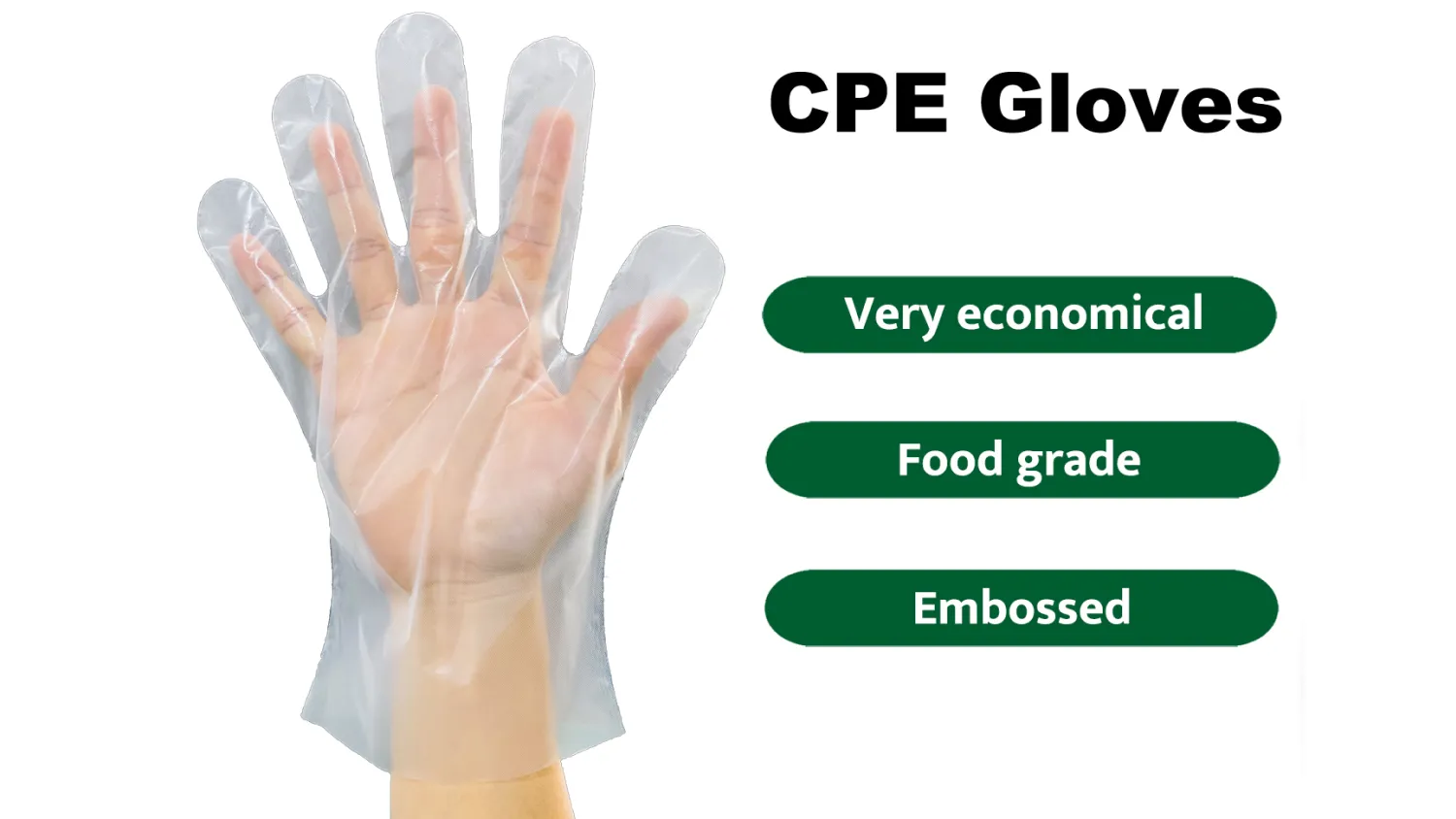
For non-clinical auxiliary services, cafeteria operations, and general sanitary support, medical centers can deploy recyclable TPE gloves. TPE delivers greater tear resistance and softer skin contact than conventional polyethylene (CPE/PE) films at an attractive cost per unit.
Critical Quality Standards & Regulatory Compliance for Healthcare Buyers
Procurement professionals must verify that medical glove shipments hold valid compliance certificates from accredited testing laboratories:
1. AQL (Acceptable Quality Limit) Pinhole Standards
The Acceptable Quality Limit (AQL) indicates the maximum allowable percentage of defective gloves (specifically water-leak pinhole barrier failures tested via ASTM D5151 or EN 455-1) within a production lot:
- Surgical Gloves: Mandated AQL ≤ 0.65 to 1.0.
- Medical Examination Gloves: Mandated AQL ≤ 1.5.
- Industrial / Food Grade Gloves: Typically AQL 2.5 to 4.0 (Strictly non-compliant for medical diagnostic or patient exam use).
A lower AQL number signifies tighter statistical quality control and a substantially lower risk of viral breakthrough during patient procedures.
2. Chemotherapy Drug Permeation (ASTM D6978 vs. ASTM F739)
Standard chemical resistance testing (ASTM F739) is insufficient for gloves used in oncology wards or compounding pharmacies. Healthcare workers handling antineoplastic (chemotherapy) drugs require gloves tested under ASTM D6978 (Standard Practice for Assessment of Resistance of Medical Gloves to Permeation by Chemotherapy Drugs).
ASTM D6978 applies a testing threshold ten times more sensitive than standard industrial testing (0.01 µg/cm²/min versus 0.1 µg/cm²/min). Premium purple medical exam nitrile gloves are specifically tested against panels of aggressive chemotherapy agents—including Carmustine, Cyclophosphamide, Doxorubicin, Fluorouracil, and Paclitaxel—satisfying USP 800 hazardous drug handling guidelines.
3. International Regulatory Standards Matrix
Before placing hospital volume purchase contracts, ensure the supplier complies with the following benchmarks:
- United States: FDA 510(k) Premarket Clearance, ASTM D6319 (Nitrile Exam), ASTM D3578 (Latex Exam), ASTM D5250 (Vinyl Exam), ASTM D3577 (Surgical).
- European Union: EU Medical Device Regulation (MDR 2017/745), EN 455 Parts 1 (Freedom from holes), 2 (Physical properties), 3 (Biological evaluation), and 4 (Shelf life determination); EU PPE Regulation 2016/425 & EN ISO 374 (Microbiological and chemical risks).
- Quality Management: ISO 13485 certification for medical device manufacturing.
Department-by-Department Healthcare Sourcing Guide
To prevent wasteful over-specification while eliminating safety vulnerabilities, hospital procurement teams should map glove specifications to specific clinical departments:
| Hospital Department | Primary Hazard Profile | Recommended Glove Specification | Primary Polymer |
|---|---|---|---|
| Operating Theaters (OR) | Invasive incisions, prolonged fluid exposure | Sterile surgical gloves (AQL ≤ 0.65–1.0, hand-specific) | Synthetic Polyisoprene / Sterile Nitrile |
| Oncology & Infusion Pharmacy | Cytotoxic chemotherapy drugs, antineoplastics | ASTM D6978 chemo-rated exam gloves, extended cuff | Purple Medical Exam Nitrile |
| Emergency & Trauma (ED) | High-stress punctures, heavy bleeding, unknown pathogens | High-durability 4–5 mil nitrile exam gloves | Blue Nitrile 4mil or Purple Exam |
| Inpatient Wards & Phlebotomy | Routine exams, diagnostic blood draws, IV lines | Standard 3.5–4.0 mil exam gloves (AQL ≤ 1.5) | Premium Nitrile Gloves |
| Central Sterile & Environmental (EVS) | Corrosive chemical disinfectants, sharp instruments | Heavy-duty, puncture-resistant flock-lined utility gloves | Flocklined Industrial Nitrile |
| Dietary, Cafeteria & Admin Support | Dry food prep, light surface sanitizing | Economical, powder-free food contact gloves | TPE Gloves or Vinyl |
Storage, Donning, and Operational Quality Best Practices
Maximizing glove barrier efficacy requires correct clinical handling and warehouse storage:
- Environmental Storage Conditions: Store medical gloves in a cool, dry warehouse between 10°C and 30°C (50°F to 86°F) with relative humidity below 65%. Protect inventory from direct sunlight, fluorescent UV bulbs, and ozone-generating equipment (such as electric motors and x-ray machines), which induce rapid polymer oxidation and micro-cracking.
- Aseptic Donning Protocol: Ensure hands are completely dry following alcohol rub or hand washing before donning. Performing hand hygiene while gloves are on is strictly prohibited.
- Beak / Glove-in-Glove Doffing: Remove gloves using the peel technique—pinching the outside of the glove near the wrist, pulling it inside-out, and holding it in the opposite hand while sliding un-gloved fingers beneath the remaining glove cuff.
- Shelf-Life Verification: Regularly rotate warehouse stock under First-In, First-Out (FIFO) procedures. Nitrile gloves typically maintain full barrier specifications for 3 to 5 years from manufacture when stored correctly.
Frequently Asked Questions (FAQ)
What is the difference between medical examination gloves and surgical gloves?
Medical examination gloves are Class I ambidextrous devices used for non-invasive patient exams and diagnostic procedures, with a mandated pinhole threshold of AQL ≤ 1.5. Surgical gloves are Class II sterile devices individually packed in pairs, featuring hand-specific ergonomic curves and a stricter pinhole standard of AQL ≤ 0.65 to 1.0 for invasive surgical interventions.
Can vinyl gloves be used for drawing blood or administering injections?
No. Vinyl gloves exhibit high rates of micro-leakage and seam failure under tensile strain. Health organizations explicitly recommend against using vinyl gloves for procedures involving bloodborne pathogens, deep body fluids, or high-risk infectious patients. Medical-grade nitrile examination gloves should always be used instead.
What does ASTM D6978 certification mean for medical gloves?
ASTM D6978 is a specialized testing standard that evaluates a glove’s resistance to permeation by hazardous chemotherapy drugs. It is significantly more stringent than standard ASTM F739 chemical testing, measuring permeation rates down to 0.01 µg/cm²/min against antineoplastic agents to protect oncology nurses and pharmacy compounding staff.
How do I verify if a medical glove meets FDA requirements?
Medical examination and surgical gloves marketed in the United States must hold a valid FDA 510(k) Premarket Notification number. Buyers should request the 510(k) clearance letter, technical data sheets (TDS), and test reports verifying compliance with ASTM D6319 and ASTM D5151 water-leak testing.
Partner with Damao Tech for Medical Glove Procurement
Selecting the appropriate disposable gloves in healthcare balances clinical safety, regulatory compliance, and budget optimization. Damao Tech supplies certified medical examination gloves, surgical barriers, and heavy-duty utility gloves to healthcare networks, distributors, and clinic systems globally.
- Request Bulk Pricing & Technical Data Sheets: Review our certified purple medical exam nitrile gloves and premium nitrile gloves.
- Explore Strategic Procurement Guides: Learn more in our complete wholesale disposable glove buying guide and our facility glove management guide.
- Contact Our B2B Medical Supply Team: Contact Damao Tech today to request laboratory test reports, sample packs, and container-load quotation.