EVA Foam Density Explained: Meaning, Chart, and Selection
EVA Foam Density Explained: Meaning, Chart, and Selection
Purchasing foam based solely on surface hardness results in rapid material failure under heavy loads. This guide explains perfectly what EVA foam density means, how engineers measure it, and how to select the exact physical parameter required for long-term structural stability.
What Does EVA Foam Density Mean?
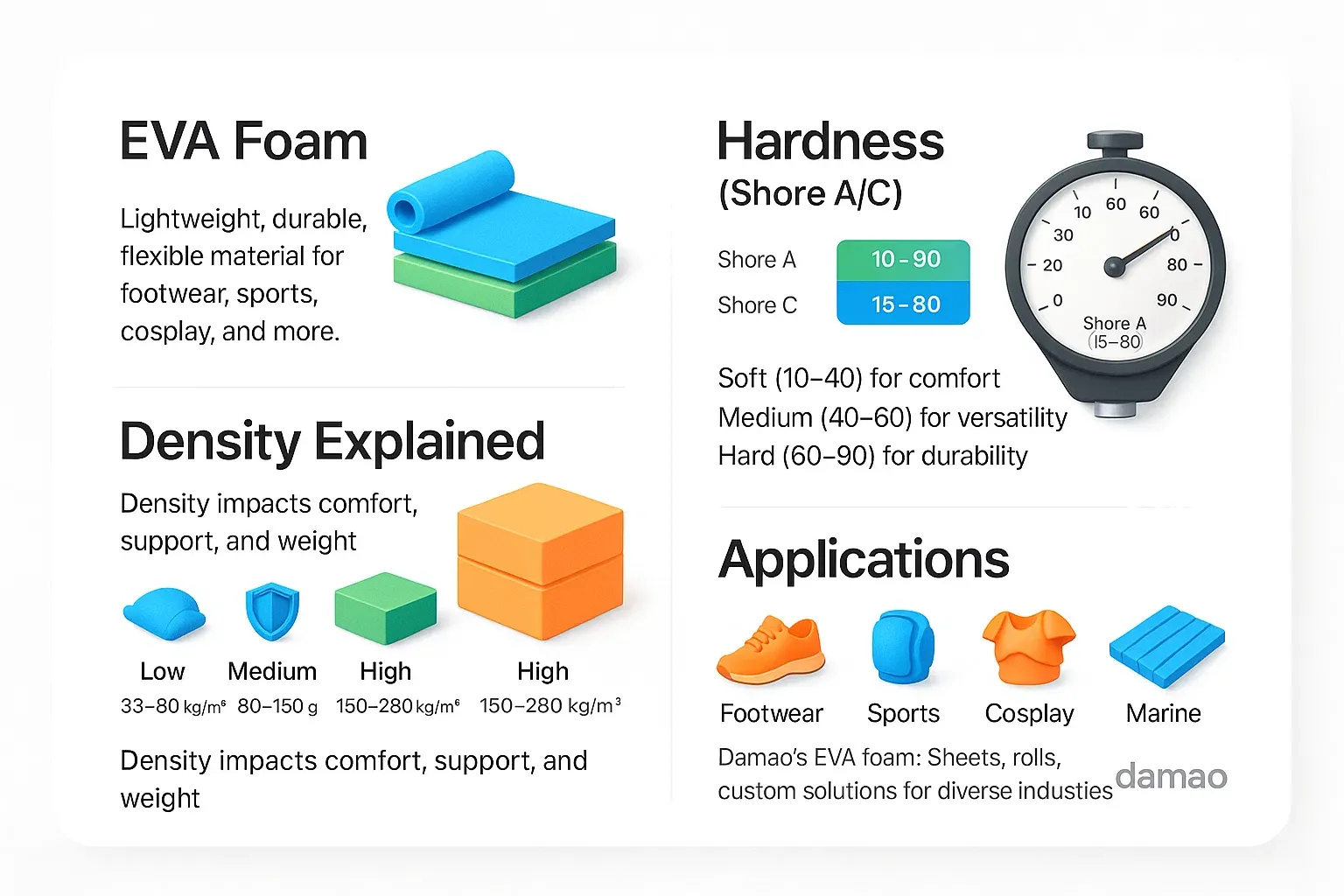
EVA foam density is the actual mass of the structural polymer divided by its total volume. We express this physical measurement strictly in kg/m³ (kilograms per cubic meter). Because density measures the total amount of raw base material injected into the foam’s microscopic walls, it directly dictates how the foam responds to constant heavy pressure.
- Low Density: Contains a high air-to-polymer ratio. It produces an ultra-lightweight foam with extreme compressibility.
- High Density: Contains a low air-to-polymer ratio. It produces a solid, heavy block capable of severe load resistance without flattening.
Typical EVA Foam Density Chart
Selecting the wrong density range causes immediate structural breakdown. Reference this standard metric chart to map physical ratings against your exact performance requirement.
| Density Range (kg/m³) | Foam Physical Characteristics | Standard Industry Applications |
|---|---|---|
| 33 – 60 | Ultra-light, highly compressible | Yoga mats, soft packaging |
| 60 – 100 | Lightweight with basic base support | Protective padding, entry-level midsoles |
| 100 – 150 | Balanced physical cushioning and stability | Athletic orthotics, marine backing |
| 150 – 220 | High strength, extremely low compression set | Tool tray inserts, heavy industrial pads |
| 220 – 280 | Very rigid, absolute shape-retentive | Heavy-duty machine components |
How Density Affects Material Performance
In our direct material testing experience, the exact density configuration radically alters how EVA physically behaves over an extended operational lifespan.
Constant Compression Resistance
Higher-density EVA resists physical flat-lining. When you place a heavy steel tool inside a high-density pocket, the dense polymer walls resist deformation, securing long-term base thickness retention.
Physical Abrasion Resistance
Dense foam resists friction. Because higher-density foams pack more physical plastic into the outer surface area, they withstand daily aggressive scrubbing, sliding, and mechanical wear much better than air-heavy low-density foams.
Finished Part Weight
Low density exponentially reduces total product weight. Product designers choose lower densities when engineering handheld equipment requiring extreme fatigue reduction for the end user.
Density vs. Hardness: Resolving the Confusion
Engineers frequently confuse density with hardness. Hardness (measured via Shore A or Shore C gauges) strictly determines surface indentation resistance. Density dictates the absolute internal mass distribution. Two identical pieces of EVA foam may test exactly at 45 Shore C, but the heavier, denser option will survive ten times longer under direct compression.
Review our related technical breakdown: EVA Foam Density & Hardness: Shore A vs Shore C
Summary and Next Steps
EVA foam density mathematically determines a product’s exact failure point under physical compression. Always specify a low density (33-80 kg/m³) for lightweight padding, and a high density (150-250 kg/m³) for heavy-duty structural parts.
Request Technical Support today to receive specific data sheets and physical sample blocks for your exact production run.