Custom Cut EVA Foam: Die Cutting vs CNC Routing for Inserts
- Damao Tech
- EVA Foam
- 03 May, 2026
When standard EVA foam sheet stock needs to become a finished B2B product—such as a protective packaging insert, an industrial gasket, or an adhesive-backed assembly pad—it must be precision cut.
Because EVA foam is highly compressible, selecting the right cutting methodology is the most critical decision in your manufacturing process. The wrong method leads to torn edges, dimensional inaccuracy, and wasted material.
At Damao Tech, we manufacture both the raw material and the finished custom cut EVA foam parts. This guide breaks down the core cutting methods (Die Cutting vs. CNC Routing), expected manufacturing tolerances, and crucial design tips for a flawless RFQ.
1. Primary Cutting Methods Compared
Different cutting methods serve different production volumes and geometric complexities.
A. Die Cutting (Best for High-Volume, Flat Parts)
Die cutting uses a custom-built steel rule die (essentially a heavy-duty cookie cutter) mounted on a hydraulic press to punch shapes out of foam sheets or continuous rolls.
- Strengths: Incredibly fast and highly economical for mass production. Ideal for flat 2D gaskets, spacers, and puzzle play mats.
- Limitations: Cannot create multi-depth pockets (3D cavities) in a single pass. The foam compresses slightly as the blade pushes through, which can cause minor “hourglassing” (concave edges) on very thick foam.
B. CNC Routing (Best for Multi-Depth Tool Inserts)
CNC (Computer Numerical Control) routers use a high-speed spinning cutting bit guided by a computer program to carve the foam.
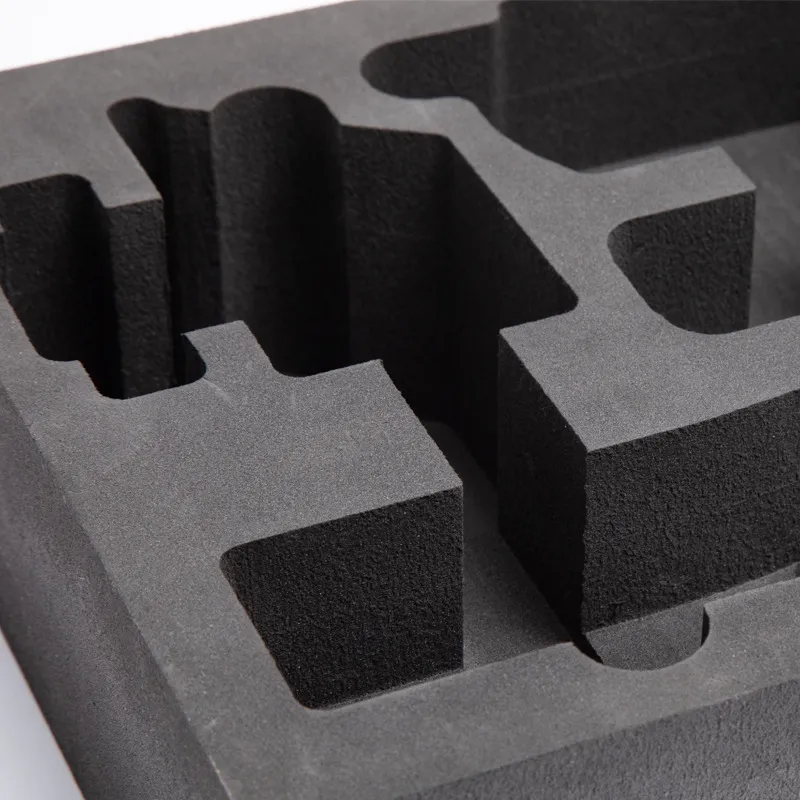
- Strengths: Can mill out 3D pockets, multi-level cavities, and precise radiused corners. Perfect for custom Pelican case inserts, camera gear protection, and tool trays.
- Limitations: Slower and more expensive per unit than die cutting. Requires high-density foam (e.g., 100+ kg/m³) to prevent the spinning bit from tearing the foam walls.
C. Waterjet Cutting
Uses an ultra-high-pressure stream of water to slice through foam.
- Strengths: Excellent for complex 2D shapes on very thick foam without causing any thermal edge damage or hourglassing.
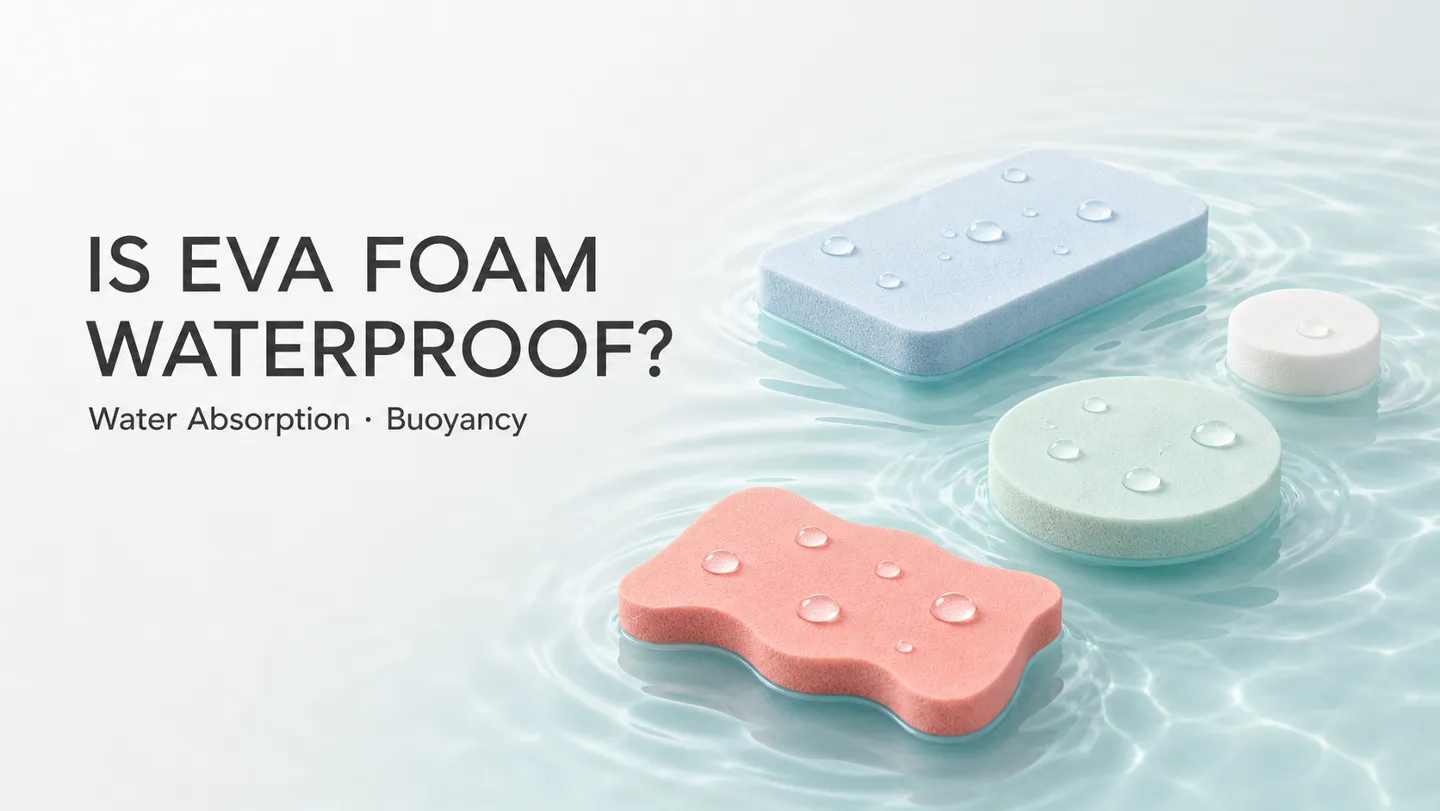
- Limitations: Requires drying time if the foam is not 100% closed-cell, though standard EVA is fully waterproof.
D. Laser Cutting
Uses a concentrated laser beam to burn through the material.
- Strengths: Ideal for intricate logos and extremely fine details.
- Limitations: Can leave a slightly hardened, melted, or discolored edge due to the heat.
2. Manufacturing Tolerances: What to Expect
Unlike machining solid aluminum, EVA foam is a flexible cellular polymer that compresses during cutting and expands/contracts with temperature changes.
If a supplier promises absolute zero tolerance on foam, they do not understand the material. For B2B custom cut EVA foam, realistic and achievable tolerances are:
- Die Cutting: ± 1.0mm to ± 1.5mm, depending on foam thickness.
- CNC Routing: ± 0.5mm to ± 1.0mm.
- Waterjet Cutting: ± 0.5mm.
Design Tip: Always identify the Critical to Quality (CTQ) dimensions on your CAD drawing. For example, if a cut pocket must perfectly grip a delicate medical device, mark that pocket as a high-tolerance zone so the CNC operator can slow the feed rate for that specific area.
3. Designing Foam Inserts: 4 Golden Rules
Good part design drastically reduces manufacturing scrap and unit cost. If you are designing a custom EVA foam insert, follow these rules:
- Avoid Razor-Thin Walls: Do not design walls thinner than 5mm between two pockets. The milling bit will tear thin walls unless you are using ultra-high-density foam.
- Include Finger Pulls: If an item (like a heavy wrench or tablet) fits snugly into a CNC-cut pocket, add semi-circular thumb cutouts so the end-user can actually pull the item out.
- Use Radiused Corners: Sharp 90-degree internal corners are difficult to cut and prone to tearing. Design corners with a minimum radius matching the cutting bit.
- Specify Adhesives Early: If the part needs Pressure Sensitive Adhesive (PSA) backing to stick to a case wall, tell your manufacturer before cutting, as the adhesive liner changes how the foam is processed.
4. How to Submit an RFQ for Custom Cut Foam
To receive an accurate and fast quote for custom EVA foam parts, ensure your RFQ includes:
- Vector or CAD Files: .DXF, .DWG, or .STEP files are preferred. (PDFs are good for reference, but cannot be fed into a CNC machine).
- Material Specs: Target density (kg/m³) and Shore hardness.
- Quantities: State your prototype quantity and expected annual mass-production volume.
- Layering / Lamination: Note if you need a dual-color layered foam (e.g., a black top layer over a red base to quickly identify missing tools).
Start Your Custom Fabrication Project
At Damao Tech, we operate an advanced fabrication facility equipped with heavy-tonnage die cutters, multi-axis CNC routers, and automated lamination lines.
Explore our custom EVA foam fabrication capabilities or contact our engineering team today to submit your CAD drawing for a manufacturability review.