How EVA Shoe Soles Are Made: Manufacturing Process Explained
- Damao Tech
- EVA Foam
- 16 Jun, 2026
Knowing how EVA shoe soles are made gives buyers, product designers, and footwear engineers a direct advantage when sourcing materials, evaluating supplier quality, and specifying production parameters. This guide covers every stage of the EVA sole manufacturing process — from raw polymer compounding through molding, expanding, and final finishing.
For footwear converters and shoe brands seeking production-grade raw stock or pre-cut components, explore our custom EVA foam sheet manufacturing hub and full EVA foam material solutions.
What Is an EVA Shoe Sole?
An EVA shoe sole is a structural or cushioning component made from Ethylene-Vinyl Acetate (EVA) foam, used as a midsole, outsole, or single-piece unit sole in athletic footwear, sandals, and casual shoes. EVA is the material of choice for shoe soles because it is lightweight (density as low as 0.15 g/cm³), provides excellent shock absorption, and can be precisely tuned for hardness and rebound through compounding.
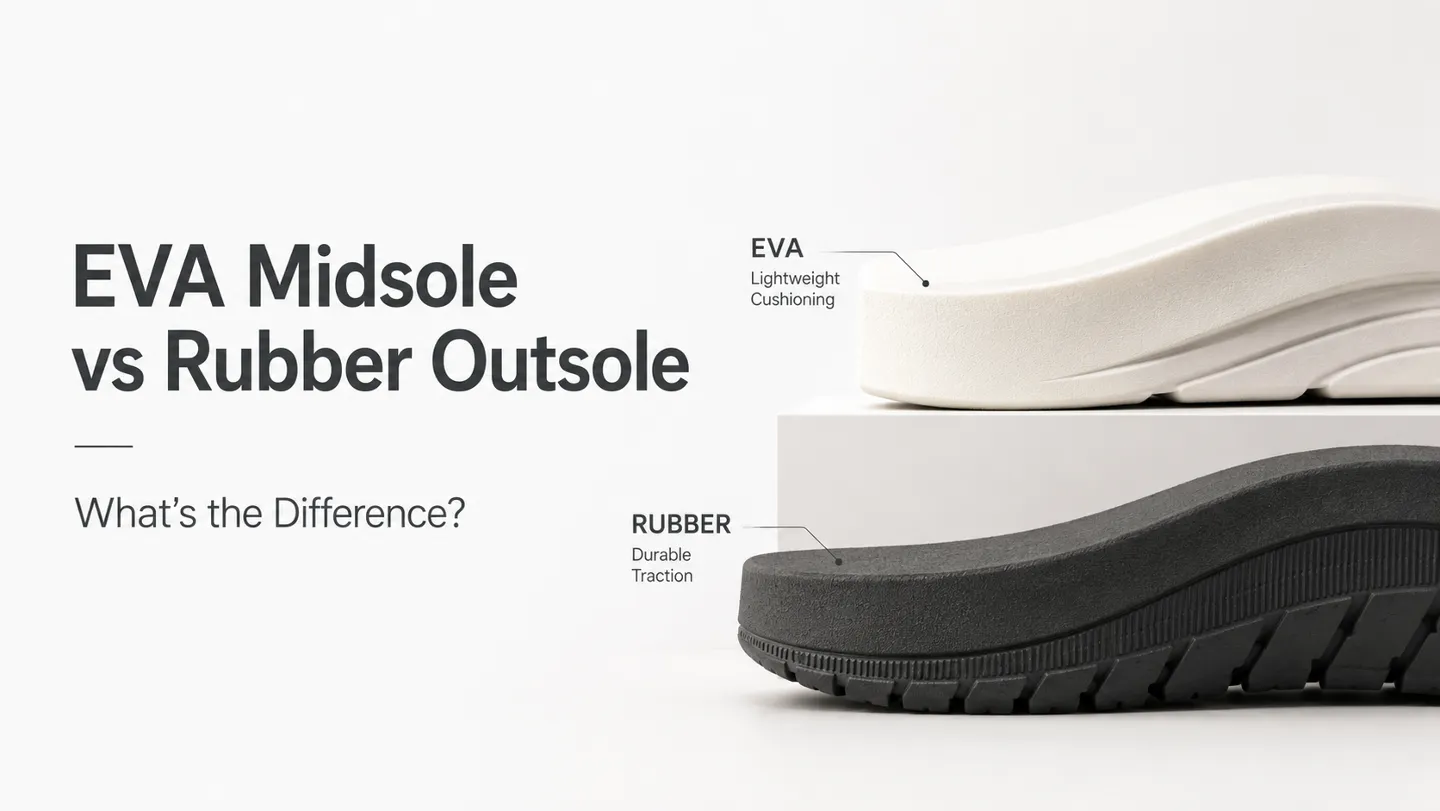
Most consumer running shoes use an EVA midsole paired with a rubber outsole. Budget casual shoes, slides, and sandals often use a single-piece EVA sole that serves both cushioning and ground-contact functions.
Step 1: Raw Material Compounding
The manufacturing process begins with compounding — blending the base EVA polymer with performance additives.
A standard EVA shoe sole compound includes:
| Ingredient | Role |
|---|---|
| EVA resin (14–33% VA content) | Base polymer — higher VA = softer, more elastic foam |
| Dicumyl Peroxide (DCP) or azodicarbonamide (AC foaming agent) | Cross-linking agent and blowing agent that creates the cellular structure |
| Zinc oxide | Activator that controls foaming temperature and cross-link density |
| Stearic acid | Lubricant and processing aid |
| Colorants / masterbatch | Achieves target color in the finished sole |
| Fillers (calcium carbonate, silica) | Cost-reduction and hardness adjustment |
| Additives (antioxidants, UV stabilizers) | Extends product lifespan |
The compounder mixes these ingredients in precise weight ratios using an internal mixer (Banbury mixer) or an open two-roll mill. Mixing temperature is typically kept below 110°C to prevent premature activation of the blowing agent. The output is a uniform, uncured EVA sheet or pellet compound ready for molding.
Step 2: Molding — Injection Molding vs. Compression Molding
Once compounded, the EVA material is shaped into a sole through one of two primary molding methods.
Injection Molding (Phylon / E-TPU Process)
Injection molding is the dominant process for high-volume athletic midsoles. The compounded EVA pellets are fed into a screw-type injection machine, melted under heat (150–175°C), and injected at high pressure into a closed, temperature-controlled steel mold.
During injection, the blowing agent activates and begins expanding the material inside the mold. When the mold opens, the pre-form shoots out and expands rapidly to roughly 150–200% of the mold cavity volume — a stage known as “free expansion.” The resulting part is then placed in a re-pressing mold and compressed back to final dimensions under heat and pressure.
This two-step injection-expansion-repress cycle produces the Phylon midsole, the most common EVA sole format in performance footwear. Phylon soles are extremely lightweight, highly uniform in cell structure, and capable of complex geometries.
Compression Molding (Direct EVA)
Compression molding uses sheet or block EVA compound, which is cut or weighed into pre-forms from calibrated EVA foam sheets and placed directly into an open mold cavity. The mold closes under hydraulic pressure (typically 100–180 kg/cm²) and heat (160–175°C) for a dwell time of 8–20 minutes depending on thickness.
During the cure cycle, the cross-linking agent and blowing agent react simultaneously — the material cross-links (curing) while expanding to fill the mold. When the mold opens, the part has expanded to final dimensions without further processing.
Compression molding is preferred for:
- Thicker one-piece EVA soles (sandal soles, platform shoes).
- Smaller production runs where tooling costs must stay low.
- Dual-density soles using two different compounds layered inside the same mold.
Step 3: Post-Molding Expansion and Sizing
Both processes produce a part that is larger than the intended final size — because EVA foam shrinks approximately 3–10% as it cools after expansion. Manufacturers account for this shrinkage by designing molds oversized to compensate.
For Phylon soles, a re-pressing (reprinting) mold brings the expanded pre-form back to exact final dimensions. The expanded foam is placed in a cold mold, pressed under controlled pressure, and heat-set in a steam or oven chamber. This step also improves surface texture uniformity and dimensional consistency.
For compression-molded EVA soles, the mold geometry itself sets the final expanded dimensions — the manufacturer engineers the mold dimensions based on known shrinkage factors for the specific compound.
Step 4: Trimming and Buffing
After demolding, EVA shoe soles have:
- Flash (thin fins of overflow material around the parting line)
- Rough or porous surface areas from gas escaping during expansion
Operators trim the flash with a blade or die cutter and then buff the sole surfaces with a rotating abrasive wheel to achieve a uniform, smooth finish. Buffing is critical for the outsole or adhesive surfaces — it creates sufficient mechanical bonding surface for the subsequent cementing step.
For high-volume lines, automated buffing machines handle trimming and surface preparation consistently and with less labor cost than manual operations.
Step 5: Surface Treatment and Painting
Many finished EVA shoe soles receive additional surface treatments before assembly:
- Painting: Roller coating or spray-applied waterborne paint gives the midsole a finished aesthetic, matching the design brief. Paint is applied in thin coats and cured in a UV tunnel or low-temperature oven.
- Printing: Logos, size marks, or technical patterns are printed onto the sole surface using screen printing or pad printing.
- Hot-stamping: Embossed logos or metallic foil branding can be applied via heat die stamps.
Surface coatings also protect the EVA from scuffing and UV yellowing — a known degradation path for low-VA EVA in prolonged outdoor use.
Step 6: Quality Control Testing & Footwear Benchmarks
Before the sole leaves the factory, it must pass rigorous physical testing:
| Test Parameter | Standard | Benchmark for Athletic Midsoles | Benchmark for Unit Soles / Sandals |
|---|---|---|---|
| Hardness (Shore C) | ASTM D2240 | 45 – 52 Shore C | 52 – 60 Shore C |
| Density (g/cm³) | ISO 845 | 0.16 – 0.22 g/cm³ | 0.20 – 0.28 g/cm³ |
| Compression Set (22h, 23°C) | ASTM D395 | < 25% | < 30% |
| Rebound Resilience | ASTM D2632 (Test H) | > 55% | > 45% |
| Tensile Strength | ISO 1798 | > 1.8 MPa | > 2.2 MPa |
| Elongation at Break | ISO 1798 | > 200% | > 180% |
| Flex Crack Resistance | Ross Flex (50,000 cycles) | No crack initiation | No crack initiation |
| DIN Abrasion Loss | DIN 53516 | N/A (bonded to rubber) | < 160 mm³ loss |
Failures in hardness or density typically trace back to incorrect compound ratios or mold temperature drift. Compression set failures usually indicate insufficient cross-link density — either too little DCP or a short cure time.
Key Process Variables That Control EVA Sole Performance
| Variable | Effect on Finished Sole |
|---|---|
| VA content (%) | Higher VA → softer, tackier, more elastic foam |
| DCP loading (%) | Higher DCP → more cross-links → firmer, lower compression set |
| Blowing agent amount | More blowing agent → lower density, lighter sole |
| Mold temperature | Too low → incomplete cure; too high → surface scorching |
| Cure time | Too short → under-cross-linked, poor compression set; too long → burned cell walls |
| Mold cavity design | Determines the expansion ratio and final geometry |
EVA Shoe Sole Formats: Which Manufacturing Process Applies?
| Sole Format | Manufacturing Process | Typical Application | Recommended Raw Stock |
|---|---|---|---|
| Phylon midsole | Injection molding + repress | Running shoes, training shoes | Crosslinkable EVA pellets |
| Compression EVA midsole | Compression molding | Casual shoes, children’s footwear | Pre-cut EVA compound blanks |
| One-piece EVA sandal sole | Compression molding | EVA sandals, flip-flops, clogs | Compounded EVA pre-forms |
| Dual-density EVA sole | Two-material compression mold | Stability running shoes | Dual-hardness pre-forms |
| Die-cut EVA midsole/insole | CNC skiving & die-cutting | Casual sneakers, work boots | EVA foam sheets & rolls |
Summary & Sourcing with Damao Tech
EVA shoe soles are made through a multi-stage process: compounding base polymer with cross-linkers and blowing agents, molding under heat and pressure (via injection or compression), allowing expansion, and finishing through trimming, buffing, and surface coating. Every performance property — from weight and cushioning to durability — is set at the compounding stage and locked in during the cure cycle.
For footwear brands and OEM buyers sourcing EVA sole components, specifying VA content, target Shore C hardness, density, and DCP loading in your technical brief ensures that the supplier manufactures to your exact performance requirement.
- Review our custom EVA foam material solutions for raw compounded blocks and pellets.
- Source die-cut raw stock from our EVA foam sheet manufacturing facility.
- Read our in-depth EVA Sole Material & Midsole Sourcing Guide for procurement specifications.
- Contact our footwear engineering team with your CAD drawing or reference sample to request material swatches and a competitive quotation.